Applications that understand signals from people and environments.
Audio, vision, movement, device state, workflow context, and human feedback become part of the system.
Real-world perception AI
Indriya builds the platform layer for applications that sense, adapt, guide, and respond beyond the screen.

Perception is the interface
Real-world AI needs more than chat. It needs multimodal context, human feedback, environmental awareness, and adaptive guidance.
Audio, vision, movement, device state, workflow context, and human feedback become part of the system.
The platform supports feedback loops for training, accessibility, restoration, and assistive experiences.
Use cases include sensory rehab, field work, education, wearables, and perception-heavy product surfaces.
Platform
Indriya combines multimodal inputs, generative reasoning, adaptive feedback, and real-world context so teams can build AI beyond the screen.
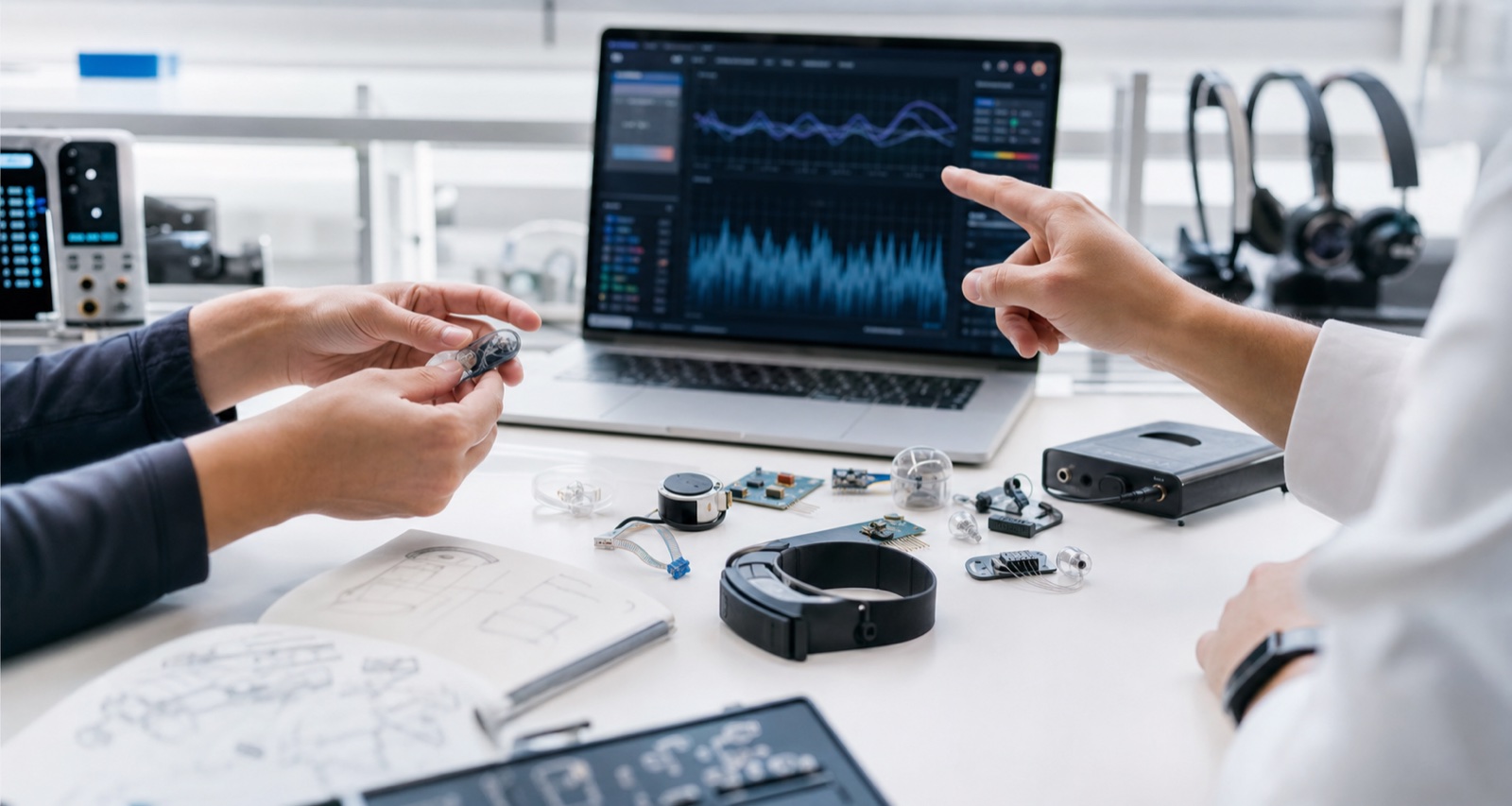
Lab to product loop
Indriya keeps those contexts connected: human feedback, device behavior, signal adaptation, and product surface.
Design surfaces
Hearing is the clearest starting wedge. The same platform ideas apply wherever AI must understand context, adapt to feedback, and guide action.
Auditory companions, acoustic scene understanding, and hearing training.
Communication support, coaching, and voice-aware product surfaces.
Visual assistance, smart glasses, spatial guidance, and inspection.
Haptics, prosthetics, tactile feedback, and assistive interfaces.
Training, rehab, field work, and embodied feedback loops.
Environment, workflow state, intent, and human-in-the-loop signals.
Solutions
Sensory rehabilitation is a flagship use case. The broader platform supports any product where AI must engage people, context, and action.
Integrate perception agents into hearing, prosthetic, training, calibration, and care workflows.
Bring adaptive guidance into hearables, smart glasses, voice systems, training tools, and field workflows.
Add context, orchestration, and adaptive feedback to AI systems that need to work beyond chat.
Proof
Indriya is building with commercial partners while preserving the research depth needed for perception-aware systems.
Pricing / configuration
Enterprise work is configured around domain, integration depth, product surface, and research collaboration. The public site can make the buying motion concrete without exposing confidential pricing.
Research signal
The site should grow into a home for research notes, experiments, and technical writing. For this version, it establishes the platform thesis and deployment categories.
Frontier models can hear, see, speak, reason, and generate. The next layer is applications that act with context.
Indriya treats perception as a loop between human state, device input, environment, feedback, and product context.
The same platform ideas extend into accessibility, education, training, field work, wearables, and assistive interfaces.
Request demo
Tell us the domain, workflow, and real-world context you are exploring. We will respond with the right integration path.